Are No-KYC Casinos Anonymous? What Their Privacy Claims Mean

No-KYC casinos let you create an account without uploading government ID. That doesn't mean you're anonymous. Your blockchain transactions sit on a public ledger. IP addresses get logged. Device fingerprints are collected. You avoid immediate identity checks but still generate traceable data. "No-KYC" reduces upfront document collection, it doesn't hide your activity or make payments untraceable. Understanding what you gain and what remains visible matters before choosing this type of operator.
What "no-KYC" actually delivers
Skip the paperwork, not the data trail.
No-KYC operators don't require Know Your Customer verification at signup. You won't submit a passport, utility bill, or proof of address when you register. That's the extent of the privacy gain.
Everything else leaves a mark. The casino logs your IP address, revealing approximate location and ISP. Device information, operating system, browser type, screen resolution, gets collected and stored. Cookies track sessions. Cryptocurrency payments? Your wallet address appears on a public, permanent blockchain ledger. None of this disappears because you skipped document upload.
Data collection, blockchain traceability, regulatory obligations
What the operator collects
Email address, device fingerprint, IP address, transaction history. That's typical. What's missing at registration: legal name, street address, government ID number.
The privacy advantage is partial and temporary. Many no-KYC operators hold a Curaçao licence with Anti-Money Laundering provisions. When you request a withdrawal, especially above certain thresholds, the operator may demand full KYC documents. Identity verification happens later, not never.
Blockchain pseudonymity versus anonymity
Cryptocurrency transactions are pseudonymous. Your wallet address is public, permanently recorded, mathematically traceable.
A wallet address isn't your name. It also isn't private. Forensic blockchain analysis can trace funds to exchanges or payment processors that do hold KYC data. If you moved crypto through a regulated exchange, your identity may already be linked to that transaction, despite using a no-KYC casino. The Bitcoin whitepaper describes the public ledger functionality that makes all transactions visible and immutable.
Privacy policy and data sharing
Encrypted connections (SSL) protect data in transit between your browser and the casino. They don't address what the operator does with stored data.
Check the privacy policy for:
- Retention period for IP addresses and device information
- Third-party data sharing or sales
- Applicable data protection laws (which jurisdiction)
A no-KYC operator that shares your session data with advertisers or analytics platforms isn't offering meaningful privacy.
Privacy claim verification table
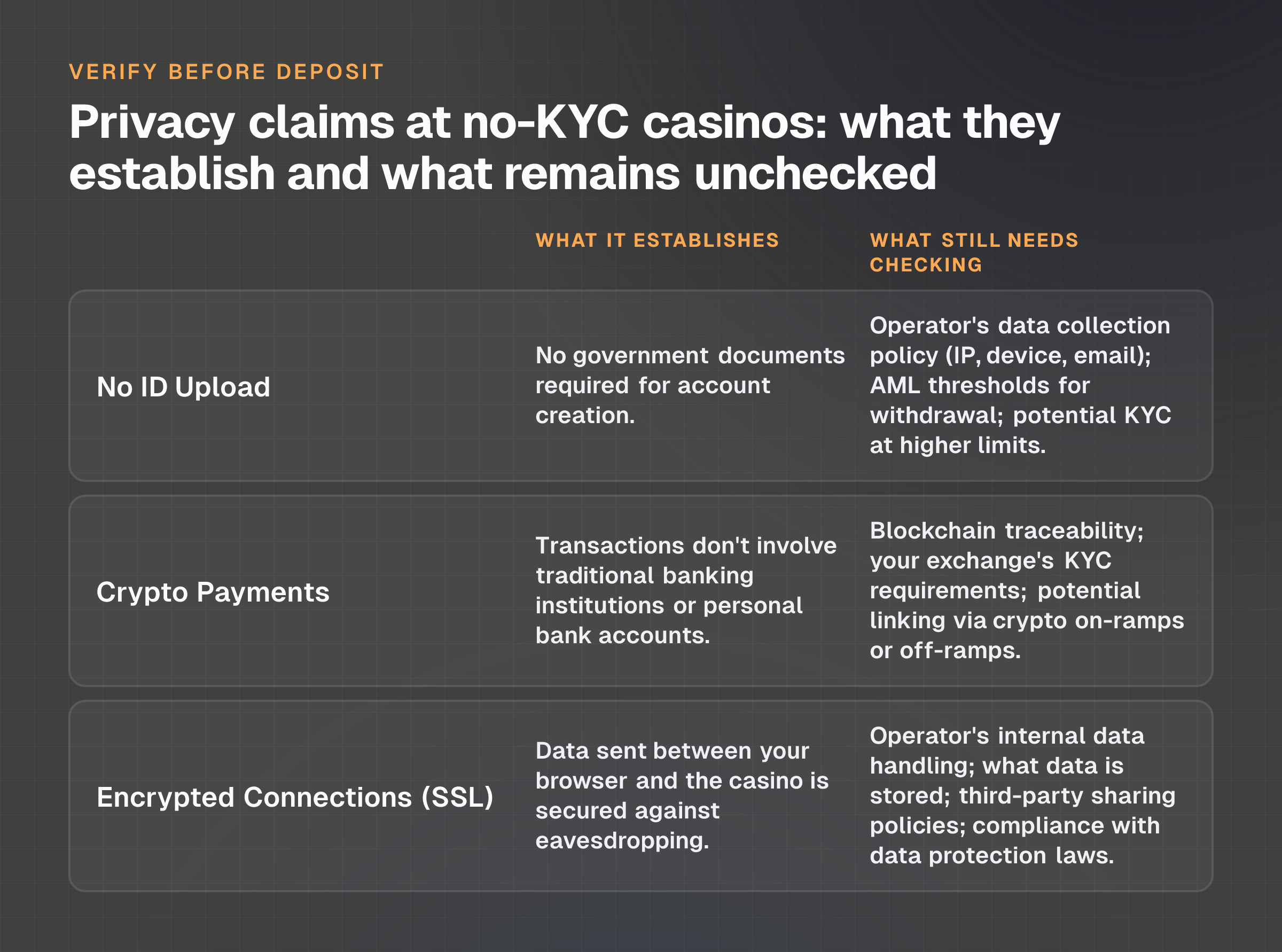
| Privacy Claim | What it Establishes | What Still Needs Checking |
|---|---|---|
| No ID Upload | No government documents required for account creation. | Operator's data collection policy (IP, device, email); AML thresholds for withdrawal; potential KYC at higher limits. |
| Crypto Payments | Transactions don't involve traditional banking institutions or personal bank accounts. | Blockchain traceability; your exchange's KYC requirements; potential linking via crypto on-ramps or off-ramps. |
| Encrypted Connections (SSL) | Data sent between your browser and the casino is secured against eavesdropping. | Operator's internal data handling; what data is stored; third-party sharing policies; compliance with data protection laws. |
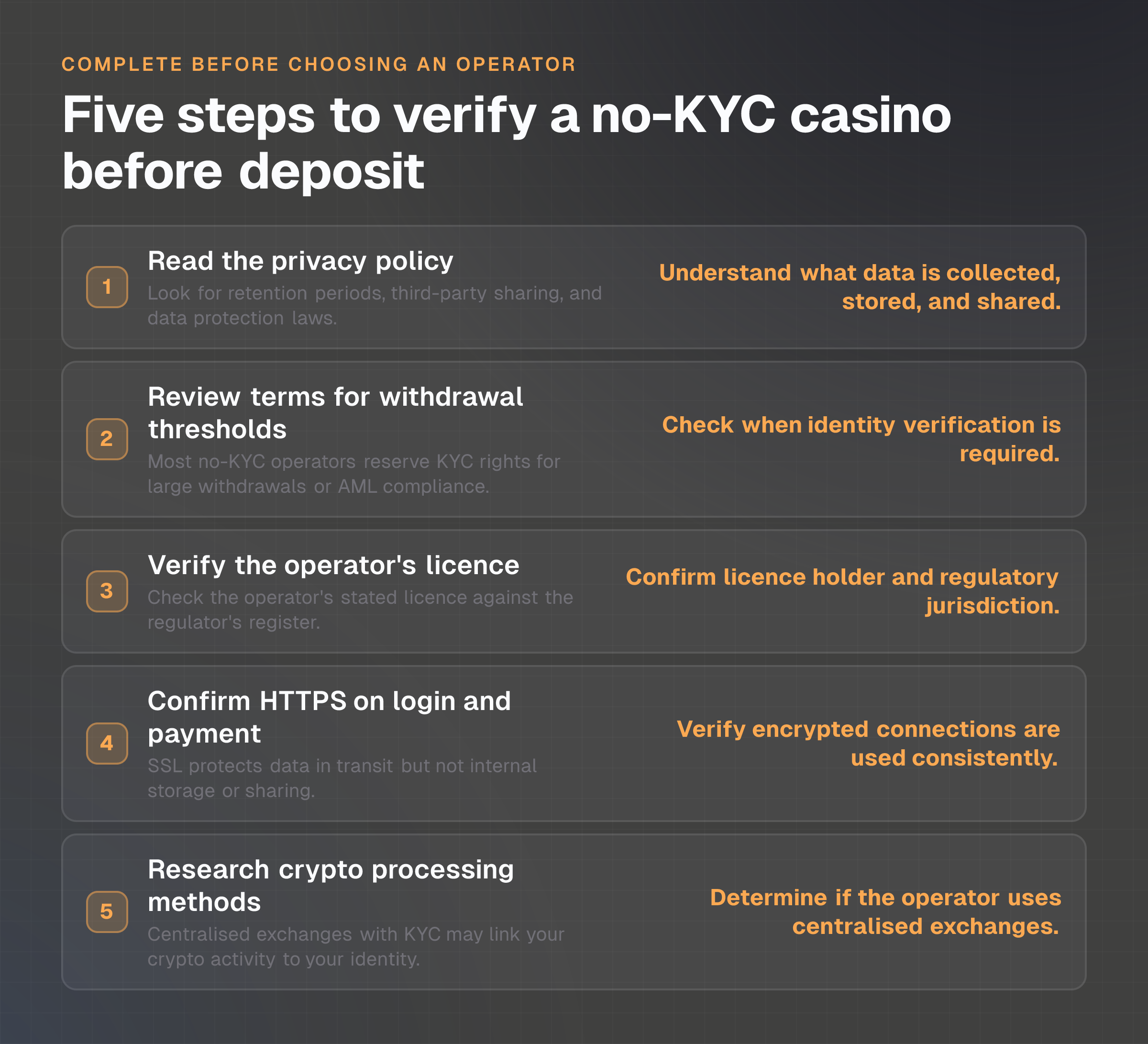
Checklist before choosing a no-KYC operator:
- Read the privacy policy. Understand what data is collected, stored, shared.
- Review terms and conditions for withdrawal thresholds that trigger identity verification.
- Check the operator's licence holder and regulatory framework.
- Confirm HTTPS is used for all login and payment pages.
- Research whether the operator uses centralised exchanges for cryptocurrency processing.
Regulatory framework and responsible gambling safeguards
No-KYC casinos typically operate under licences with different oversight than UKGC or Malta Gaming Authority jurisdictions. This affects dispute resolution, fund segregation, and responsible gambling tool availability.
Reduced immediate identity verification doesn't mean less regulation. It reflects a different regulatory model with its own compliance obligations and trade-offs.
Before depositing, verify the operator's licence and regulatory standing. A licence issued in one jurisdiction may offer different protections than one in another.
Responsible gambling is critical. Online gambling is for adults 18+ only. Skipping immediate identity checks can make cross-platform self-exclusion harder if your identity isn't consistently recorded. Set deposit and time limits. Use the operator's responsible gambling tools. If you struggle with gambling, seek help through WhatCasino's responsible gambling resources.
The trade-off: privacy from immediate identity checks in exchange for less regulated player protections and ongoing data collection. Neither choice is inherently safer. They represent different priorities. Choose based on whether you prioritize reduced upfront data submission or stronger regulatory oversight of KYC-required operators.
Affiliate disclosure: When you register or deposit at a casino through links on WhatCasino, we may receive a commission. This supports our research. Our analysis draws on licence registers, published operator terms, and payment method documentation, not operator influence. Read more about how WhatCasino ranks and discloses.
FAQ
Can a no-KYC casino track my activity?
Yes. IP addresses, device fingerprints, session cookies, and transaction histories are logged. "No-KYC" means no immediate identity documents, not no data collection.
Are cryptocurrency payments anonymous at no-KYC casinos?
No. Cryptocurrency transactions are pseudonymous. Wallet addresses appear on public blockchain ledgers. Forensic analysis can trace funds, especially if they passed through a KYC-compliant exchange.
Will I ever need to verify my identity at a no-KYC casino?
Possibly. Many no-KYC operators reserve the right to request identity documents for large withdrawals, AML compliance, or suspected fraud. Check the operator's terms for withdrawal thresholds.
Do no-KYC casinos operate without regulation?
No. Most hold a licence (often Curaçao-based) with regulatory obligations, including AML provisions. The regulatory framework differs from UKGC or MGA jurisdictions but isn't absent.
How do I check what data a no-KYC casino collects?
Read the privacy policy. Look for sections on data collection, retention periods, third-party sharing, and applicable data protection laws. If the policy is vague or missing, choose a different operator.
What's the main privacy risk at a no-KYC casino?
Believing "no-KYC" means anonymous. You still generate traceable data through IP logs, device information, and blockchain transactions. Privacy gains are limited to skipping immediate document upload.