Casino Crypto Payments: Check Networks, Fees and Withdrawals
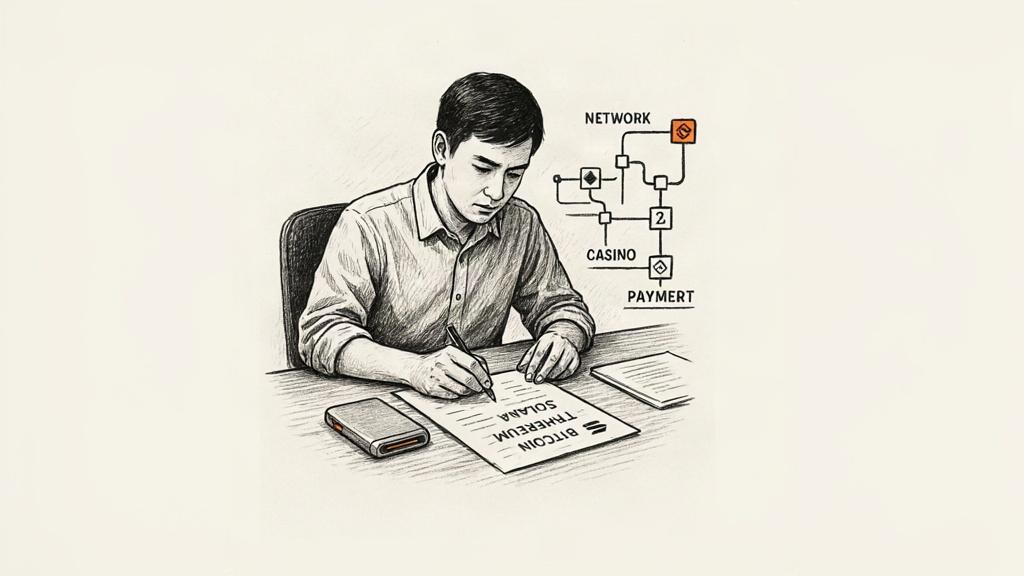
Determining which cryptocurrencies and blockchain networks an online casino accepts is the first practical step in evaluating whether crypto payments suit your account. You need to check the casino's published payment documentation to identify accepted digital assets, the specific networks they operate on, deposit and withdrawal procedures, transaction limits, fees, and processing times. The technical distinction between blockchain confirmation and operator approval matters: send cryptocurrency to the wrong network and you'll lose those funds permanently, while settlement times vary between blockchain speed and the casino's internal approval process.
This article examines how to verify crypto payment compatibility using published operator documentation and terms as of 7 November 2026. It separates the information you need to check yourself from the gaps in publicly disclosed data, and defines the key concepts, cryptocurrencies, blockchain networks, wallet addresses, and settlement processes, that determine whether a specific casino's crypto option will work for your transaction.
Finding and coverage: published cryptocurrency and network acceptance
Casinos publish cryptocurrency payment options on dedicated Banking, Payments, or FAQ pages. A clear statement of accepted cryptocurrencies is the basic threshold.
But the specific blockchain network is equally crucial.
The distinction matters because a single cryptocurrency can operate on multiple networks. Tether (USDT), for example, runs on the Ethereum network (as USDT-ERC-20), the Tron network (USDT-TRC-20), and Solana. Send USDT-TRC20 to an ERC-20 address, or vice versa, and the transaction is irreversible, you'll typically lose those funds permanently. This article doesn't include a current directory of which casinos accept which cryptocurrencies and networks, as operator payment pages change and require real-time verification against each casino's current banking terms.
The research identifies the following categories of information that must be checked in a casino's official documentation:
- Explicit list of accepted cryptocurrencies (Bitcoin, Ethereum, Litecoin, Ripple, Tether)
- Specific blockchain networks for each cryptocurrency (USDT on ERC-20, TRC-20, or Solana)
- Deposit and withdrawal procedures with step-by-step instructions
- Minimum and maximum transaction amounts for crypto deposits and withdrawals
- Any casino-imposed fees separate from blockchain network fees
- Advertised processing or settlement times
- KYC (Know Your Customer) or AML (Anti-Money Laundering) requirements for crypto transactions
- Terms and Conditions clauses covering cryptocurrency payment policies
Data and method: verification steps and definitions
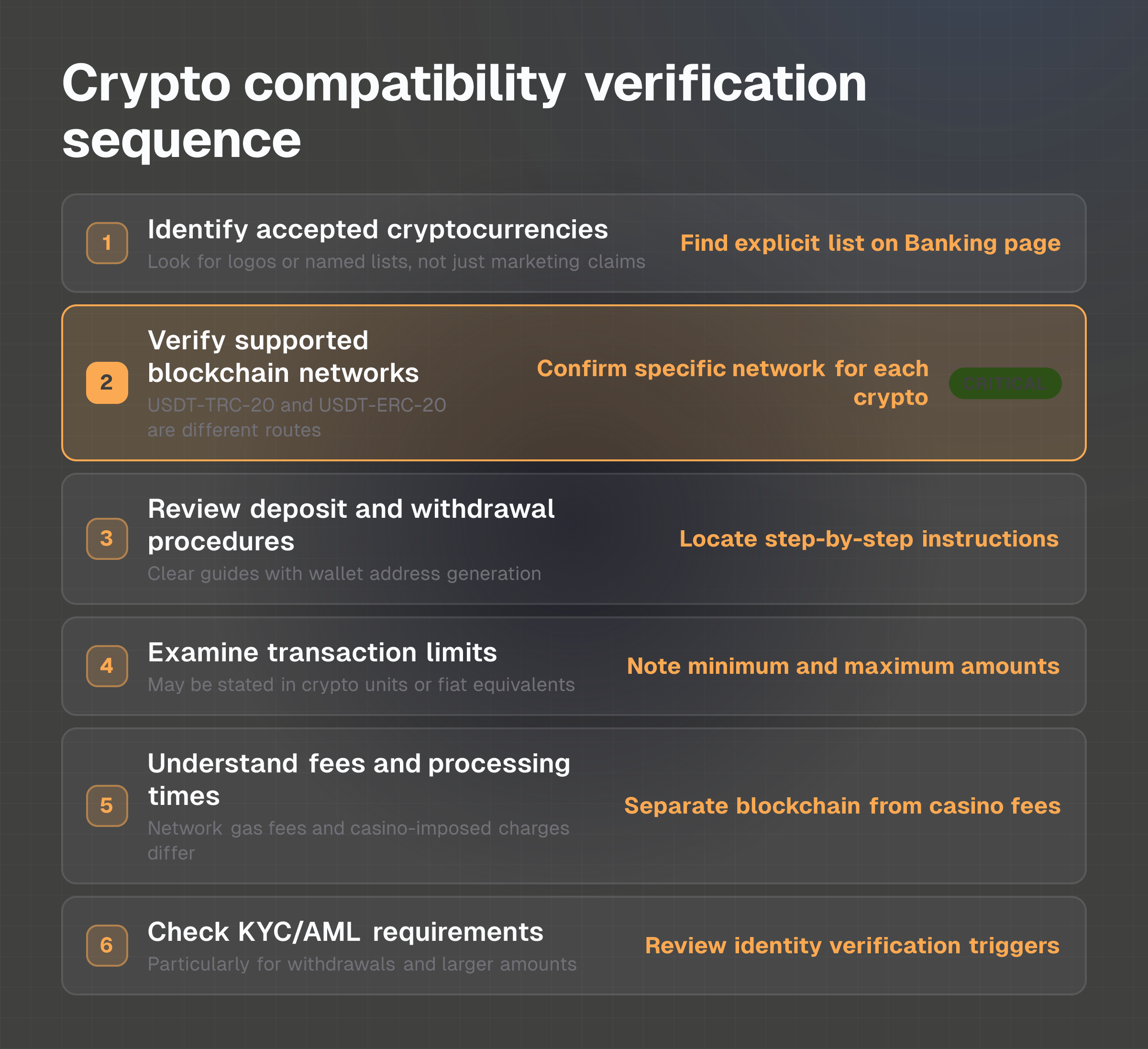
To check crypto payment compatibility at a specific casino, follow a structured sequence that separates blockchain operations from casino policy.
Step 1: Identify accepted cryptocurrencies.
Visit the casino's official Banking or Payments page. Look for logos or named lists of accepted digital assets. The threshold is an explicit, published statement, marketing claims alone aren't sufficient.
Step 2: Verify supported blockchain networks for each cryptocurrency.
This is critical. Don't assume a cryptocurrency name alone is enough. Confirm the specific network(s) the casino accepts. "USDT (TRC-20)" and "USDT (ERC-20)" are different payment routes. Sending to the wrong network is generally irreversible.
Step 3: Review deposit and withdrawal procedures.
Find detailed instructions for how to initiate a crypto deposit (typically "send [amount] of [cryptocurrency] to this address") and how to request a withdrawal. Clear, step-by-step guides with visuals or explicit text are the threshold.
Step 4: Examine transaction limits.
Locate the minimum and maximum amounts allowed for crypto deposits and withdrawals. Note whether these limits are stated in cryptocurrency units (BTC, ETH) or fiat equivalents (GBP, USD).
Step 5: Understand fees and processing times.
Distinguish between two types of fees:
- Blockchain network fees (gas fees): Paid to miners or validators to process the transaction on the blockchain. These vary based on network congestion and can't be controlled by the casino.
- Casino-imposed fees: Any additional charge the casino applies to crypto transactions. This article doesn't include specific casino fee rates, as these change and require verification against current terms.
Processing times similarly have two components:
- Blockchain confirmation time: The time for the transaction to be recorded and confirmed on the blockchain itself. This varies by network and congestion.
- Casino approval time: The casino's internal processing, which may include anti-fraud checks and can add time beyond blockchain confirmation.
Step 6: Check KYC/AML requirements for crypto transactions.
Review the casino's Terms and Conditions and AML policy. Crypto transactions, particularly withdrawals and larger amounts, may trigger identity verification processes. Assuming crypto payments are anonymous can lead to surprises during withdrawal.
Step 7: Consult operator terms and conditions.
Always review the complete Terms and Conditions and any specific Payment Terms clause. Look for policies governing cryptocurrency volatility, exchange rates (if the casino converts to fiat), and dispute resolution.
Key concepts: cryptocurrency, networks, and wallet addresses
Cryptocurrency: A digital or virtual currency secured by cryptography, making counterfeiting and double-spending nearly impossible. Examples include Bitcoin (BTC), Ethereum (ETH), Litecoin (LTC), Ripple (XRP), and Tether (USDT).
Blockchain network: The distributed ledger technology underlying a cryptocurrency. Different cryptocurrencies operate on different networks. Bitcoin operates on the Bitcoin network; Ethereum operates on the Ethereum network. Tether (USDT) can operate on multiple networks, Ethereum (ERC-20), Tron (TRC-20), Solana, and others. The specific network is crucial for transaction compatibility.
Wallet address: A unique identifier used to send and receive cryptocurrency on a specific blockchain. Addresses are network-specific: a Bitcoin wallet address can't receive Ethereum, and an ERC-20 address can't receive TRC-20 tokens.
Transaction fee (network or gas fee): A fee paid to the miners or validators of a blockchain network to process and confirm a transaction. These fees vary based on network congestion and the cryptocurrency. They're not set by the casino.
Settlement and confirmation: The time for a transaction to be processed and confirmed on the blockchain, and subsequently approved by the casino. Blockchain confirmation time and casino approval time are separate processes and both contribute to the total settlement duration.
On-chain vs. off-chain transactions: On-chain transactions are recorded directly on the blockchain. Off-chain transactions occur outside the blockchain, often within a centralized exchange or payment provider, and may be settled on-chain later.
KYC/AML: Know Your Customer and Anti-Money Laundering regulatory requirements. Casinos must verify the identity of users, which may apply specifically to crypto transactions.
Results and interpretation: common mistakes and irreversible risks
Verifying crypto payment compatibility before depositing or withdrawing is essential because several mistakes are irreversible and result in permanent fund loss.
Wrong network, permanent loss: Sending cryptocurrency to the incorrect blockchain network is the most common, often irreversible mistake. Send USDT-TRC20 to an Ethereum (ERC-20) address and the funds typically can't be recovered. Always confirm the exact network the casino specifies before sending any amount.
Volatility between initiation and settlement: Cryptocurrency values fluctuate rapidly. The fiat value of a crypto deposit or withdrawal can change significantly between the time you initiate the transaction and when it settles. The casino's conversion rate at settlement may differ from the rate when you began the process.
Confusing blockchain fees with casino fees: Network fees (gas fees) are paid to blockchain validators and vary based on congestion, the casino doesn't control these. Casino-imposed fees are separate. Understanding which fees apply requires checking the casino's current payment terms.
Delayed transactions and approval times: While blockchain transactions can be fast, network congestion causes delays. Casinos apply internal approval processes for withdrawals, which add time beyond blockchain confirmation. Advertised processing times are often estimates, not guarantees, and may vary based on operator workload and anti-fraud checks.
KYC surprises: You may assume crypto transactions are anonymous and be surprised by identity verification requirements, particularly for withdrawals. This article doesn't cover which casinos trigger KYC at specific transaction sizes; individual casino terms must be consulted.
Irreversibility of confirmed transactions: Once a cryptocurrency transaction is confirmed on the blockchain, it's generally irreversible, unlike some traditional payment methods such as card chargebacks. This makes verification before sending critical.
Outdated information: Casino payment pages and terms change. Always check the most current documentation directly from the operator's official site, not from cached or third-party sources.
What this comparison does and does not cover
This article explains the verification process and the definitions casinos use in their payment documentation.
It doesn't provide:
- A real-time directory of which casinos accept which cryptocurrencies and networks (this requires checking each casino's current banking page)
- Current network congestion or gas fee rates (these are dynamic and must be checked via blockchain explorers at the time of transaction)
- Specific processing times for individual casinos' crypto withdrawals (these are typically estimates and vary by operator workload and anti-fraud procedures)
- The exact exchange rates casinos use when converting crypto to fiat (these are rarely disclosed and fluctuate)
Readers evaluating a bounded dataset of casinos should verify each operator's current payment page and terms independently, using the seven-step framework above.
Limits and practical use: what readers should verify independently
This article provides the framework for checking crypto compatibility at any casino. Application requires verification at each operator's official documentation, as payment options change and differ between casinos.
Before depositing or withdrawing crypto:
- Log into your account at the casino and navigate to the Banking or Payments section.
- Locate the cryptocurrency and network you plan to use (Bitcoin on the Bitcoin network or USDT on TRC-20).
- Note the exact wallet address the casino provides. Don't copy it from anywhere but the official casino page.
- Confirm the minimum and maximum transaction amounts for that cryptocurrency.
- Check the casino's current Terms and Conditions for any KYC, fee, or processing time policies for crypto.
- Before sending, verify the network and address one final time, irreversible mistakes are common.
After initiating a transaction:
Use a blockchain explorer (specific to the network, Etherscan for Ethereum, Tronscan for Tron) to track your transaction's on-chain status. This shows blockchain confirmation time, separate from the casino's internal approval. Consult the casino's FAQ or support if the transaction doesn't appear in your account after blockchain confirmation. The casino may require additional internal processing or verification.
Gaps in publicly available data:
This article doesn't cover real-time network fee rates, specific casino internal processing times, or operator-specific exchange rates, these are dynamic, operator-dependent, or not publicly disclosed. Casinos don't typically publish average withdrawal completion times or aggregate settlement data by cryptocurrency.
Responsible gambling reminder:
Cryptocurrency gambling carries inherent risks, including market volatility and the irreversibility of transactions. Always gamble responsibly, within your means, and seek help if you feel your gambling is becoming a problem. For support and guidance, consult the Responsible gambling resources available.