A Guide to Comparing Casino Welcome Bonuses

Evaluating a welcome bonus means looking past the advertised sum to understand what you can actually win and withdraw. Two bonuses with identical headline values, say, £200, can differ vastly in real value depending on wagering requirements, game contribution rates, withdrawal limits, and expiry dates. This guide walks you through the key terms and decision steps used to assess bonuses fairly, so you can compare offers on their actual terms rather than marketing alone.
This comparison draws on published bonus terms and official casino conditions. The process separates what casinos advertise from what their full terms allow, helping you identify which bonuses suit your play style and budget.
Finding and coverage: published bonus terms and eligible games
Casino operators publish welcome bonus terms on their promotional pages and in full conditions. This analysis covers the key policy areas that define a bonus's real value: the advertised headline amount, minimum deposit requirements, wagering multipliers, game contribution percentages, maximum bet limits during bonus play, withdrawal caps, expiry periods, eligible games, and accepted payment methods.
Bonus terms are set by the operator and vary significantly between offers. No two bonuses are identical, even when their headline amounts match. Some casinos publish simplified summaries on promotional pages alongside full terms and conditions; others disclose detail only in the extended T&Cs. The complete picture emerges only when you read both sources.
This article doesn't cover complaint data, observed completion rates, or customer success measures, those lie outside published policy. The focus is on the rules as stated by the operator at the time of publication.
Data and method: the ten-step evaluation process
To compare bonuses fairly, follow these steps in order. Each one isolates a specific element that changes how much you can win, how long it takes, and how much you must wager.
Step 1: Assess the headline offer
Note the advertised bonus amount and structure.
Examples include "100% up to £200," "50 Free Spins," or "200% up to £500 + 100 Free Spins." The headline tells you the maximum bonus credit or number of spins you can receive, but not what you must do to use or withdraw it.
Step 2: Identify the minimum deposit
Find the lowest amount you must deposit to trigger the bonus. If the advertised bonus is "100% up to £200," the minimum deposit is typically £200 to receive the full £200 bonus. Some offers have lower minimums; read the T&Cs to confirm.
Step 3: Examine wagering requirements
Wagering requirements (also called playthrough or rollover) state how much money you must wager using bonus funds before you can withdraw any winnings. The requirement is expressed as a multiplier.
Find the multiplier: Look for phrases like "20x bonus," "30x bonus + deposit," or "50x." The number is the multiplier.
Check what it applies to: Does the requirement multiply only the bonus amount, or the bonus plus your deposit? A "30x bonus" means you wager the bonus 30 times. A "30x bonus + deposit" means you wager the bonus and your deposit combined 30 times. The second is stricter.
Calculate total turnover: Multiply the amount subject to the requirement by the multiplier to find the total wager you must place.
For example, a £100 bonus with a 30x requirement = £3,000 in total wagers. A £200 bonus with a 50x (bonus + deposit) requirement where your deposit was £200 = £20,000 in total wagers.
Step 4: Review game contribution rates
Not all games contribute equally to wagering requirements. This is one of the largest sources of hidden differences between bonuses.
Identify your preferred games: Do you typically play slots, table games (blackjack, roulette, baccarat), or live casino?
Check contribution percentages: Slots often contribute 100%, every pound you wager on a slot counts in full toward the requirement. Table games frequently contribute 10%, 5%, or 0% (excluded entirely). If you wager £10 on a slot game, it counts as £10 toward wagering. If you wager £10 on a table game that contributes 10%, it counts as only £1.
Calculate effective wagering: If your preferred game contributes less than 100%, your effective wagering requirement is higher.
Suppose you receive a £100 bonus with a 30x requirement (£3,000 total wagers). If you play slots (100% contribution), you wager £3,000. If you play blackjack (10% contribution), you must wager £30,000 to accumulate £3,000 in "counted" wagers.
Note exclusions: Some bonuses exclude certain games entirely, you can't use bonus funds on them, or they don't count toward wagering at all. If your preferred game is excluded, the bonus may be unusable for you.
Step 5: Look for maximum bet limits
While using bonus funds, casinos often impose a maximum bet per spin or hand. This limit prevents rapid bonus clearance and extends play time.
A common maximum bet limit is £5 or £10 per spin on slots. If the maximum is £5 and your wagering requirement is £3,000, you must place at least 600 spins at £5 each. If you breached the maximum bet limit during play, the casino can forfeit the bonus and any associated winnings.
Step 6: Check for withdrawal limits (max cashout)
A withdrawal limit caps the maximum amount you can cash out from a bonus, even if you win more.
This is especially common with free spins or smaller bonuses.
For example, a bonus might offer 50 Free Spins on a slot with a maximum cashout of £50. If you win £200 from those spins, you can withdraw only £50; the remainder is forfeited.
Larger deposit bonuses often have no maximum cashout on winnings, provided wagering requirements are met. Always check the T&Cs for this term, it can dramatically reduce the real value of an offer.
Step 7: Note expiry dates
Bonuses must be claimed and used within a stated timeframe.
Expiry dates typically range from 7 days to 30 days, though some extend longer.
A short expiry combined with high wagering requirements can make a bonus impossible to clear. If you have 7 days to wager £20,000, you must wager roughly £2,857 per day, a significant commitment that may not suit your play style or schedule.
Step 8: Verify eligible games for free spins
If the bonus includes free spins, check which specific games they can be used on. Free spins on a game you don't enjoy may have little practical value.
Also confirm: do the free spins contribute to wagering requirements? If not, they may be a separate bonus within the bonus, with their own wagering terms.
Step 9: Confirm accepted payment methods
Some casinos exclude certain payment methods, such as e-wallets like Neteller or Skrill, from bonus eligibility. If you deposit with an excluded method, you may not receive the bonus or may not be able to use it.
Confirm your preferred deposit method is eligible before depositing.
Step 10: Read the full terms and conditions
All details are stated in the bonus T&Cs.
Mistakes like playing excluded games, exceeding the maximum bet limit, or attempting to withdraw before wagering is complete can result in bonus forfeiture and loss of associated winnings.
Always read the full T&Cs before opting in to a bonus. Don't rely on the promotional summary alone.
Results and interpretation: comparing two bonuses with equal headlines
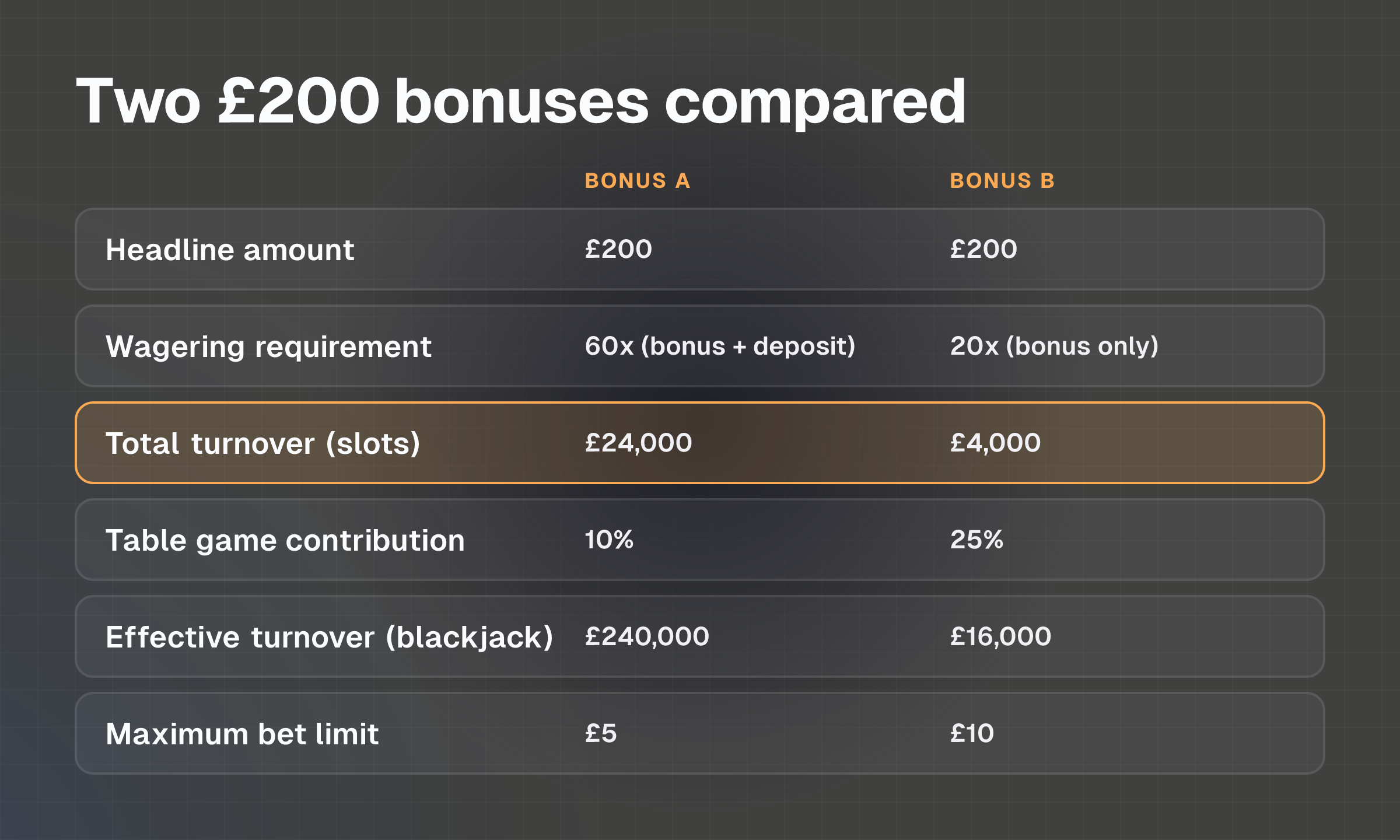
Two bonuses with identical headline values can offer vastly different real value. The following comparison illustrates why headline amount alone is insufficient.
Bonus A: "£200 bonus"
- Wagering requirement: 60x (bonus + deposit)
- Game contributions: Slots 100%, table games 10%
- Maximum bet limit: £5 per spin
- Withdrawal limit: None
- Expiry date: 14 days
- Minimum deposit: £200
If you deposit £200 and receive £200, your total turnover is £400 × 60 = £24,000.
If you play slots, you wager £24,000 over 14 days, roughly £1,714 per day. If you prefer blackjack (10% contribution), your effective requirement becomes £240,000 in bets, which is infeasible in 14 days. For a table game player, this bonus is practically unachievable.
Bonus B: "£200 bonus"
- Wagering requirement: 20x (bonus only)
- Game contributions: Slots 100%, table games 25%
- Maximum bet limit: £10 per spin
- Withdrawal limit: None
- Expiry date: 30 days
- Minimum deposit: £200
If you deposit £200 and receive £200, your total turnover is £200 × 20 = £4,000.
If you play slots, you wager £4,000 over 30 days, roughly £133 per day. If you play blackjack (25% contribution), your effective requirement becomes £16,000 in bets, still manageable over 30 days at roughly £533 per day.
Both bonuses have a £200 headline value. Bonus B is substantially more attainable for most players because it applies the wagering requirement to the bonus only (not the deposit), allows a higher per-spin bet, and includes longer expiry. The 25% contribution rate on table games in Bonus B also makes it viable for blackjack players.
This example shows why comparing the headline alone leads to poor decisions. Bonus A may appear generous but is harder to clear; Bonus B offers better real value for most play styles.
What this analysis covers
This guide examines published bonus terms, the rules as stated by the operator.
It doesn't assess whether bonuses are regularly completed, how often customers meet withdrawal limits, or whether complaint rates are high or low. Those measures require separate data on outcomes and customer experience, which lie outside published policy.
The ten-step process applies to all welcome bonuses with published T&Cs. It works for sign-up bonuses with deposits, no-deposit bonuses, free spin offers, and reload bonuses.
What to avoid
The headline trap: A large bonus amount with 50x+ wagering and low game contributions for your preferred games is less valuable than a smaller bonus with 20x or 30x requirements and higher contributions.
Chasing losses: Depositing additional money to try to meet wagering requirements can lead to further financial loss. Bonuses are tools to extend play, not to recover losses.
Breaching terms: Exceeding the maximum bet limit, playing excluded games, or withdrawing before wagering is complete will result in bonus forfeiture. Follow the T&Cs precisely.
Time pressure: Don't accept a bonus with an expiry date and wagering requirement you can't realistically meet within the timeframe. Incomplete wagering means the bonus and any winnings are lost.
Ignoring game contributions: Assuming all games contribute equally is a common error. Table game contributions can be 1/10th of slot contributions or zero. Verify contributions for your preferred games before opting in.
Payment method exclusion: Depositing with a method that doesn't qualify for the bonus means you don't receive it, even if you meet all other conditions.
Sticky bonus lock: Some bonuses are "sticky", the bonus funds can't be withdrawn even after wagering. Only winnings derived from the bonus after meeting the requirement can be withdrawn. The original deposit remains locked. Confirm whether the bonus is sticky or non-sticky before committing.
Responsible gambling
Always gamble responsibly and within your means. Bonuses are promotional tools, not guaranteed profit. Set a budget you can afford to lose and stick to it.
If gambling stops being fun or you feel you're chasing losses, seek help. Resources like GamCare and the National Gambling Helpline (0808 8020 133) are available free and confidentially.
For more detail on what you can withdraw after meeting bonus terms, see Casino Bonus Terms Explained: What Can You Actually Withdraw?. If you want to understand how expiry dates work in practice, read Casino Bonus Expiry: What Happens to Your Winnings?. For information on how long withdrawals take once your bonus is cleared, see Casino Withdrawal Times: Processing and Payment Delays.
When choosing a casino beyond the bonus, use How to Choose an Online Casino: Checks Beyond the Bonus to verify the operator's licence and safety record. Browse available casinos to compare options, or learn how WhatCasino evaluates operators by reading How WhatCasino ranks and discloses.