How to Complain About an Online Casino in Great Britain
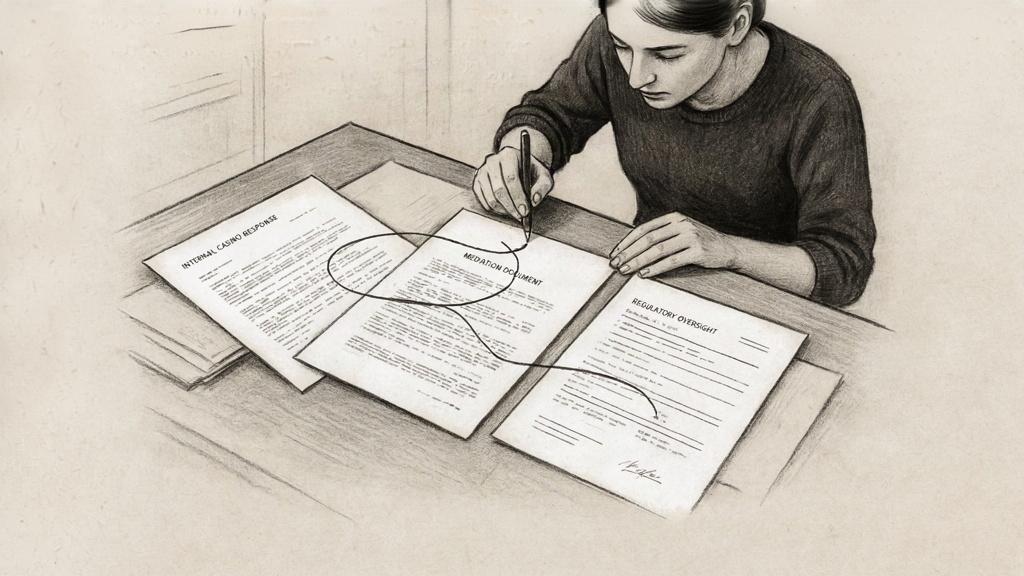
When a casino dispute arises in Great Britain, withdrawals stall, bonuses vanish, account closures make no sense, you need a clear route through the formal complaint process. This guide walks through the three-stage system for operators licensed by the Gambling Commission: internal resolution, independent mediation, and regulatory oversight. It also covers deposit limits, self-exclusion tools, and where to find confidential support if gambling becomes problematic.
These protections apply only to operators holding a valid Gambling Commission licence. Unlicensed sites offer no recourse.
If you're concerned about your gambling or that of someone close to you, confidential help is available now. Contact GamCare at 0808 8020 133 or visit www.gamcare.org.uk. Seeking support and pursuing a complaint can happen at the same time; they address different needs.
Last verified: November 9, 2026
Finding and coverage: complaint routes for GB-licensed operators
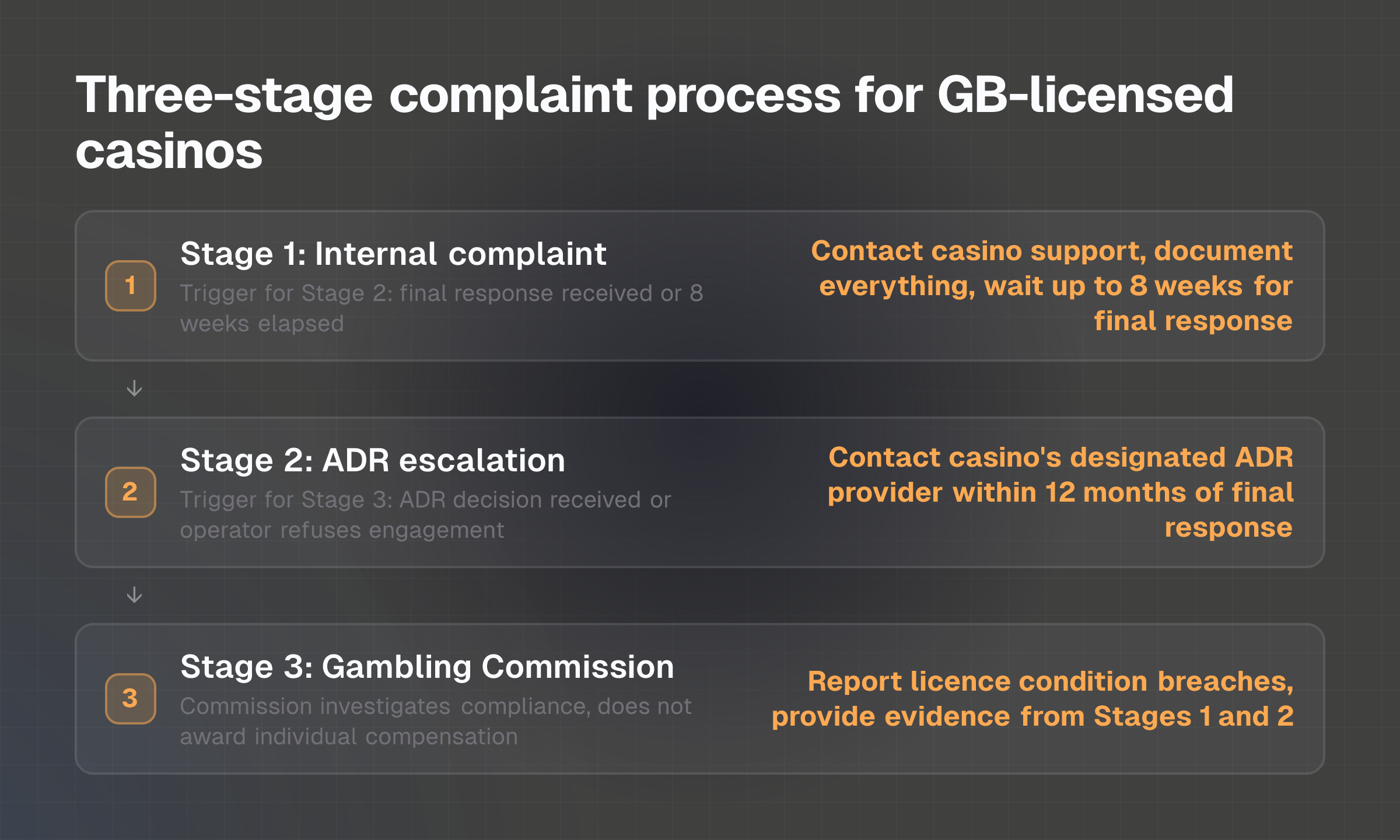
Player rights in Great Britain rest on the operator holding a valid Gambling Commission licence. Licensed online casinos follow a three-stage complaint model: internal resolution, independent mediation through an Alternative Dispute Resolution (ADR) provider, and regulatory oversight by the Commission itself.
Start with the casino directly. Document everything. Keep emails, chat transcripts, dates, names of support staff. State your complaint clearly, reference the relevant terms and conditions, and specify what resolution you're seeking.
Under Gambling Commission licence conditions, the casino must acknowledge your complaint and provide a final response within eight weeks from receipt. If you're dissatisfied with that response, or if eight weeks pass without one, you can escalate to an ADR provider approved by the Gambling Commission. The casino is legally obliged to name its ADR provider in the terms and conditions and in its final response.
The Gambling Commission doesn't mediate individual disputes. Its role is to ensure operators comply with their licence conditions. You can report systemic failings, an operator refusing to engage with an ADR, ignoring the 8-week deadline, to the Commission after exhausting the internal complaint and ADR routes. This can trigger regulatory action and help identify patterns of misconduct.
Stage 1: Internal complaint to the casino
Contact the casino's customer support via email, live chat, or phone. State your complaint clearly: include dates, times, game IDs, transaction IDs, and the resolution you're seeking. Keep detailed records of all communications, names of support staff, chat transcripts, email exchanges.
Wait for a final response. The casino must respond within eight weeks. If they respond earlier with "deadlock letter" language confirming the end of their internal process, that triggers the timeframe for escalation to an ADR.
Stage 2: Escalation to an ADR provider
Check the casino's final response or terms and conditions for the name of its designated ADR provider. Contact the ADR provider directly with your case details, the casino's final response, and supporting evidence.
Meet the ADR's deadline. Most ADR providers accept complaints within 12 months of the casino's final response. Review the ADR's decision terms, some decisions are binding, others advisory. The ADR will specify which applies to your case and dispute amount.
Stage 3: Reporting to the Gambling Commission
Complete the internal complaint and ADR processes first. Contact the Gambling Commission only if you believe the operator has breached licence conditions or failed to follow correct procedures, refusing ADR engagement, ignoring the 8-week response deadline.
Document the breach clearly: what happened, when, and which licence condition may have been breached.
Results and interpretation: separating process requirements from outcomes
Escalating a complaint follows a defined route, but completing that route doesn't guarantee a specific financial or operational outcome. ADR providers mediate based on evidence and adherence to published terms, not emotional appeals or unverified claims.
The Gambling Commission's role is regulatory compliance. It doesn't award compensation to individual players directly.
Common mistakes that weaken complaints:
Failing to document interactions. Without records of dates, names, and communications, your case lacks evidence.
Bypassing the casino's internal process. Going directly to an ADR or the Gambling Commission will result in rejection or redirection. You must complete the casino's procedure first.
Missing the ADR deadline. If more than 12 months pass after the casino's final response, most ADR providers will reject your complaint outright.
Misunderstanding ADR authority. ADR providers can't override the casino's published terms; they assess whether the operator followed its own rules and relevant regulations.
Ignoring responsible gambling tools. If your complaint involves excessive deposits or lack of betting controls, note whether the casino offered and you declined deposit limits, time-outs, or self-exclusion options. This context matters.
Limits and practical use: betting controls and self-exclusion
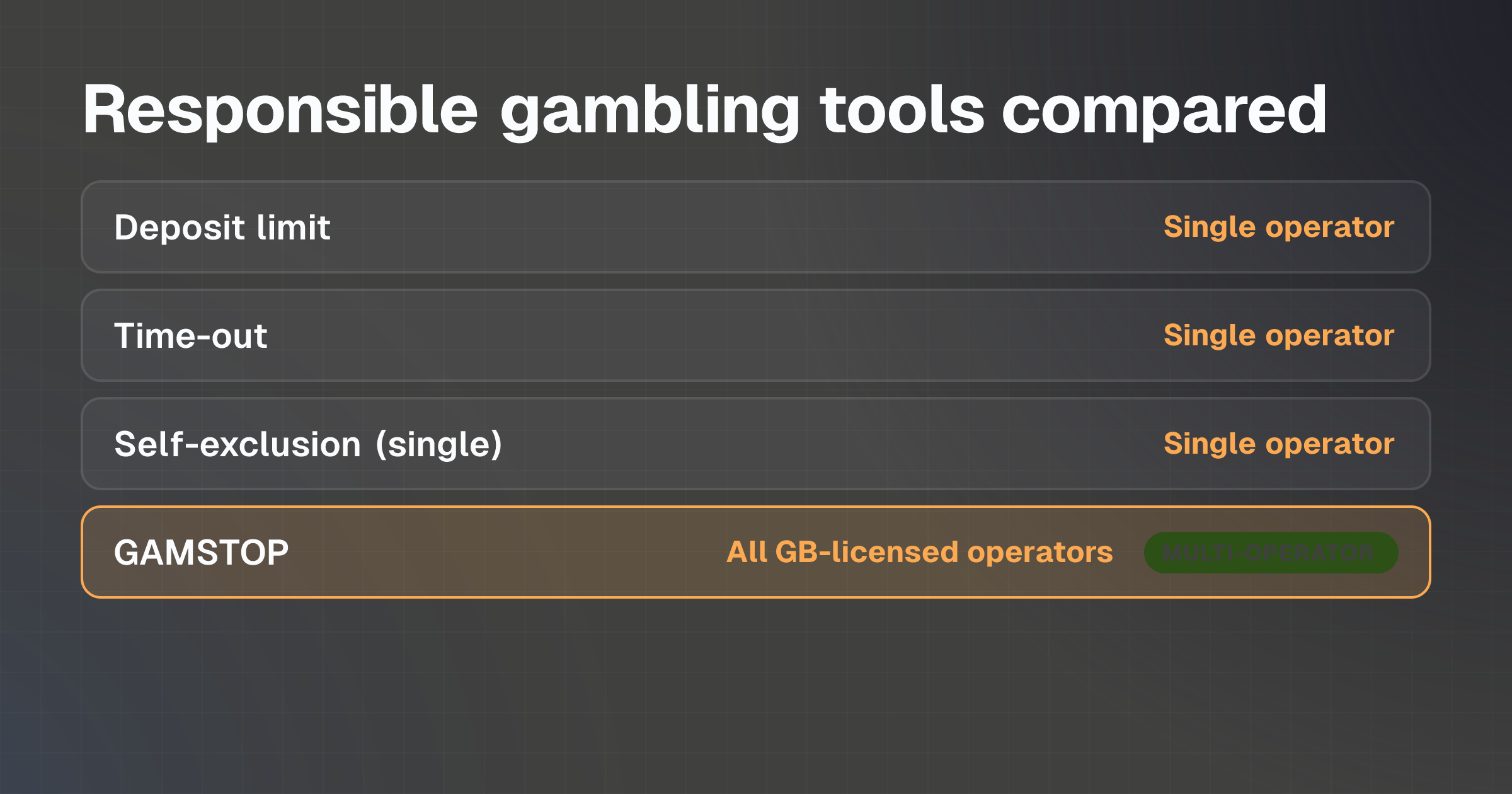
Beyond complaints, licensed casinos must provide tools to help you manage your gambling. These are separate from the complaint process but equally important.
Setting deposit limits
Log into your casino account and find the "Responsible Gambling," "Account Settings," or "Safer Gambling" section. Select the option to set a daily, weekly, or monthly deposit limit. Enter your chosen amount, once set, you can't deposit more within that timeframe.
Decreasing a limit takes effect immediately. Increasing a limit typically involves a cooling-off period (24 hours or 7 days) to give you time to reconsider.
Using time-outs
In your account's responsible gambling section, select "Time Out." Choose a duration, typically from 24 hours up to 6 weeks. During this period, you'll be unable to log in or gamble with that operator.
Single-operator self-exclusion
Contact the casino's customer support and request to self-exclude. Confirm the duration: 6 months, 1 year, 5 years. The operator must block you from accessing your account and prevent you from opening new accounts. They must also remove you from marketing lists.
After the self-exclusion period ends, reactivation requires a direct request and a minimum 24-hour cooling-off period.
Multi-operator self-exclusion via GAMSTOP
GAMSTOP is a free, multi-operator self-exclusion scheme covering all online gambling operators licensed in Great Britain.
Visit www.gamstop.co.uk and register with your details: name, address, date of birth, email addresses, and mobile numbers. Choose your self-exclusion period, 6 months, 1 year, or 5 years. Once active, you can't log in to existing accounts or open new ones with any participating GB-licensed operator.
GAMSTOP self-exclusion can't be cancelled or shortened during the chosen period. After the period ends, you must contact GAMSTOP to have your exclusion lifted, which involves a minimum 24-hour cooling-off period.
Accessing gambling support
If you or someone you know is experiencing gambling-related harm, confidential support is available:
GamCare: Freephone 0808 8020 133, www.gamcare.org.uk. Offers free, confidential advice, counselling, and support groups.
Gordon Moody: www.gordonmoody.org.uk. Provides specialist support for gambling-related problems.
These services operate independently of complaint processes and can be accessed in parallel with formal dispute resolution.