How to file a casino complaint: Pathways and escalation stages
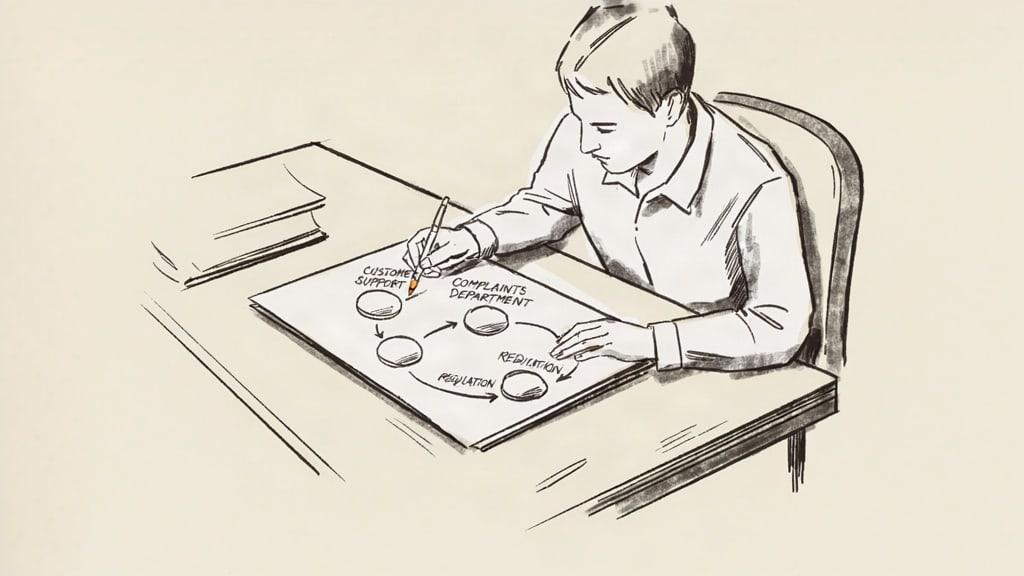
Filing a formal complaint against an online casino follows a structured escalation path: start with the casino's customer support, move to its internal complaints department, then to an independent dispute resolver if needed, and finally to the licensing regulator if earlier steps fail. The entire process typically spans weeks or months. Success depends on clear evidence and exhausting each stage before moving to the next.
Most complaints are resolved at the internal stage if documented properly and submitted within the casino's required timeframe. Understanding what counts as valid grounds, what evidence to gather, and which regulator oversees your casino saves time and improves the likelihood of a fair hearing at every level.
Finding and coverage: Formal complaint pathways and escalation stages
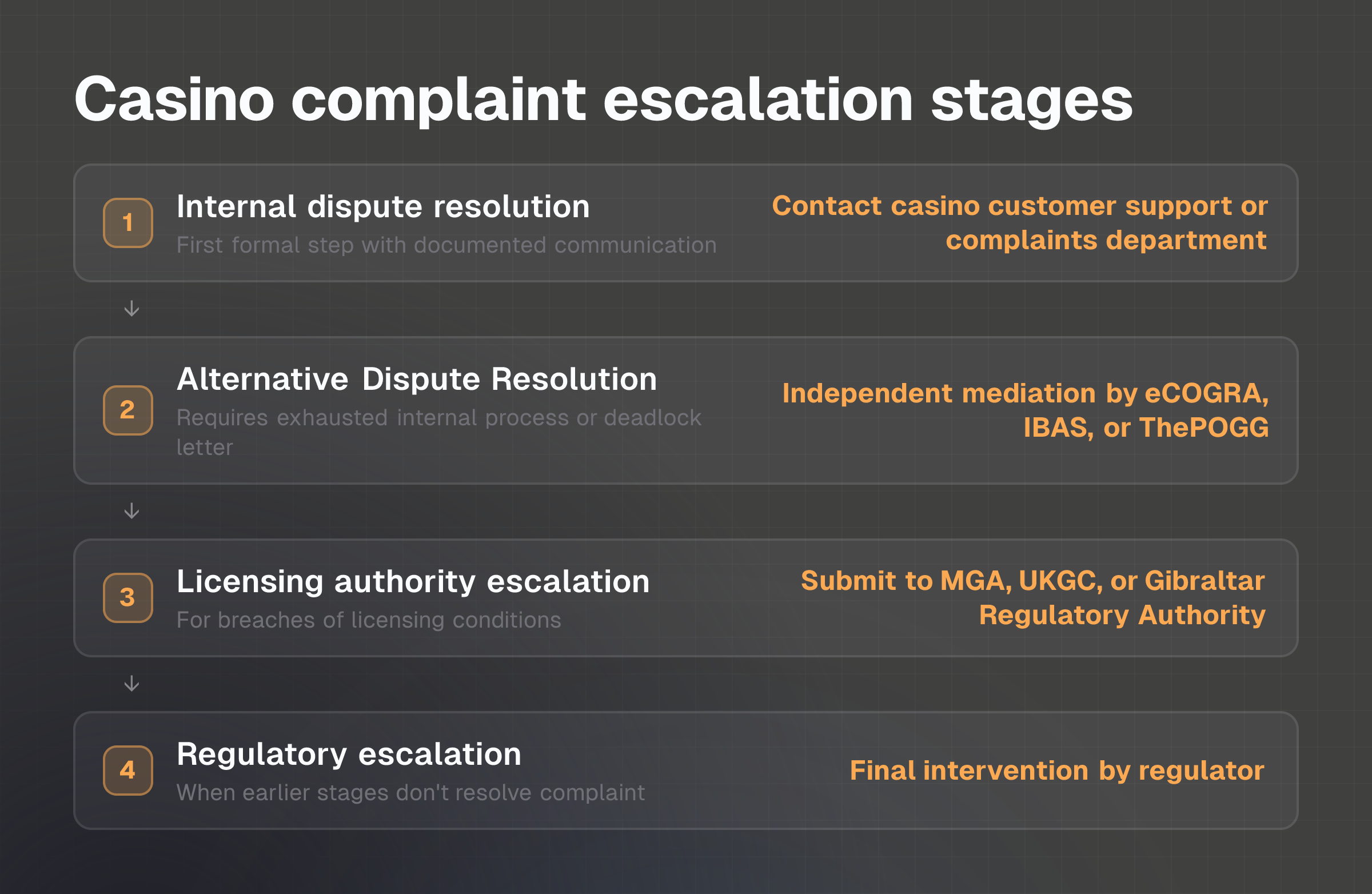
Online casino complaints cover formal expressions of dissatisfaction by a player against a gambling operator, typically involving delayed payments, bonus disputes, account closures, or unfair game outcomes. The process runs through four distinct stages, each with its own criteria and timeframes.
Internal dispute resolution is the player's direct attempt to resolve the issue with the casino's customer support or complaints department. Alternative Dispute Resolution (ADR) involves independent third-party mediation by organisations such as eCOGRA, IBAS, or ThePOGG. Licensing authority escalation means taking the complaint to the regulator that issued the casino's licence, examples include the Malta Gaming Authority, UK Gambling Commission, and Gibraltar Regulatory Authority. Regulatory escalation is the final intervention point when earlier stages don't resolve the complaint.
Not every complaint reaches all four stages. Many are settled internally; others may bypass ADR if the regulator handles the complaint type directly. The specific path depends on the casino's licensing jurisdiction, the type of issue, and whether all prior channels have been properly exhausted.
Data and method: What constitutes a valid complaint and required documentation
Before initiating any formal complaint, review the casino's Terms and Conditions, particularly sections covering dispute resolution, withdrawals, and bonus policies. This step establishes whether the complaint falls within the scope of stated rules and identifies the casino's internal complaint procedure.
Initial contact and documentation
The first formal step is always to report the issue directly to the casino's customer service via live chat, email, or telephone. Document all communication thoroughly.
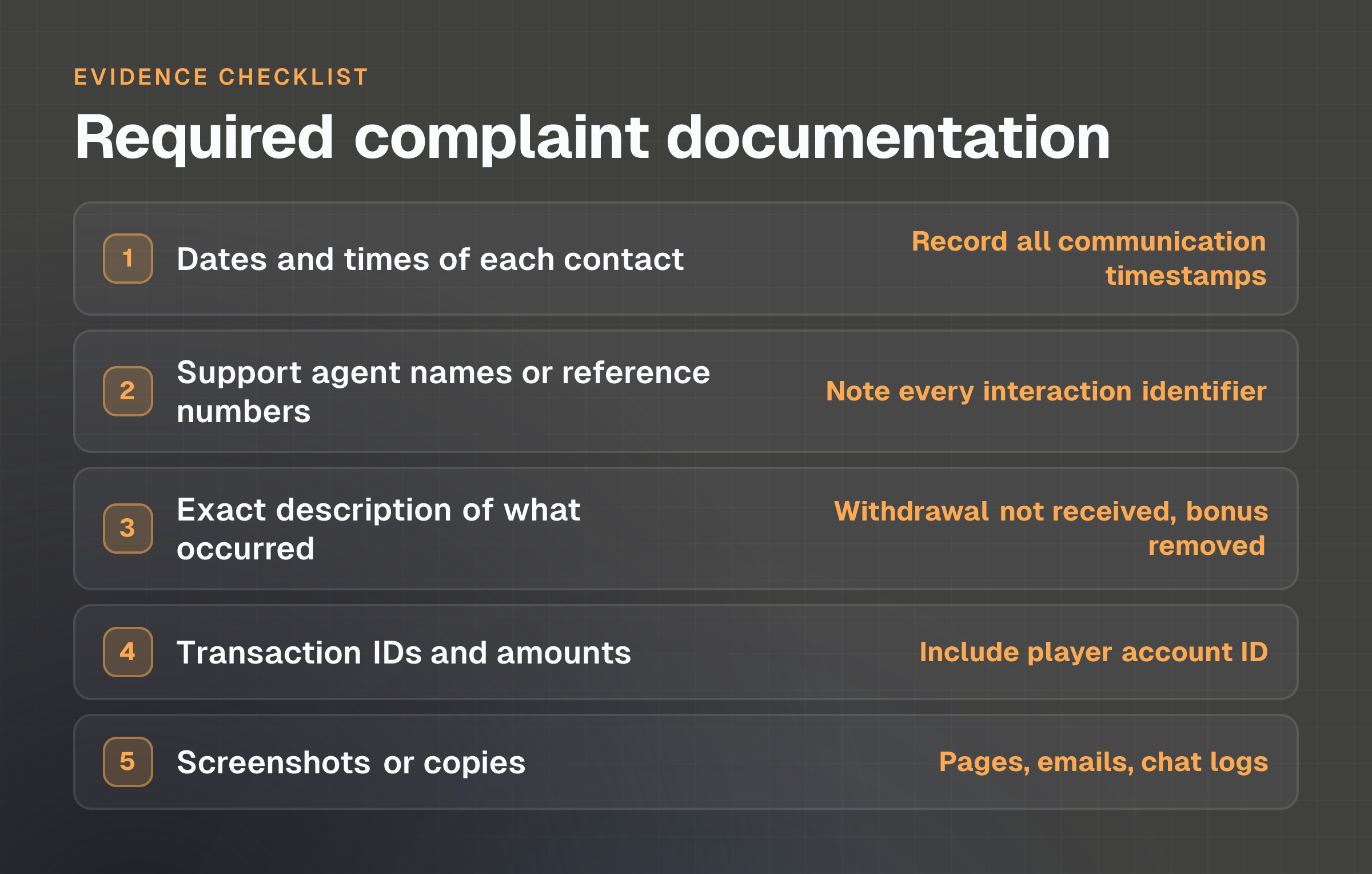
Record dates and times of each contact. Note names of support agents or reference numbers provided. Write exact descriptions of what occurred, withdrawal submitted but not received, bonus credited but then removed. Keep transaction IDs, player account ID, and amounts involved. Save screenshots or copies of relevant pages, emails, or chat logs.
This documentation forms the evidence base for all subsequent escalations. Complaints lacking clear evidence or complete transaction details are harder to substantiate and less likely to succeed at any stage.
Escalation to internal complaints department
If initial customer support contact doesn't resolve the issue, formally escalate the complaint within the casino's internal complaints procedure. This typically involves submitting a detailed complaint via a dedicated email address or online form.
Casinos are required by their licensing authorities to acknowledge complaints within a specific timeframe, ranging from 8 to 14 days for initial response, up to 8 weeks for final decision under UK Gambling Commission rules, and to issue either a resolution or a "deadlock letter" confirming that internal resolution isn't possible. Failure to receive a satisfactory response within this period triggers the right to escalate externally.
Common documentation mistakes
Submitting a complaint with missing details can delay the process or lead to rejection. Player account ID, specific dates, amounts involved, these matter. Emotional grievances without factual support are less effective than clear, evidence-backed accounts of the issue.
The stronger the factual basis and the more complete the supporting material, the faster the complaint moves through each stage.
Results and interpretation: Success rates and escalation outcomes at each stage
The Gambling Commission (UK) study published in November 2018 noted that approximately 3,000 complaints were escalated to Alternative Dispute Resolution providers in 2017/18, indicating that a measurable portion of cases don't resolve internally.
Alternative Dispute Resolution (ADR) process
If the casino's internal process yields no satisfactory outcome or deadlock letter, the next step is to lodge a complaint with an approved ADR provider. The specific provider depends on the casino's licensing jurisdiction and the provider listed in its Terms and Conditions.
ADR providers mediate disputes between players and operators, conducting their own investigation and applying their own timeframes for resolution. Players must demonstrate that they've exhausted the casino's internal complaints procedure and haven't received a satisfactory outcome within the stipulated timeframe before ADR accepts the complaint.
Licensing authority escalation
As a final resort, if ADR doesn't result in a satisfactory resolution, or if the casino isn't required to use an ADR for the specific complaint type, the player can file a complaint directly with the online casino's licensing authority.
Licensing bodies such as the Malta Gaming Authority and the UK Gambling Commission maintain public registers of licensees and provide specific complaint submission channels on their official websites. The MGA's "Player Support" section outlines the steps for submitting a complaint.
Regulators generally require evidence that all previous avenues, internal casino resolution, ADR, have been exhausted. They typically intervene in cases where there's a breach of licensing conditions or regulatory frameworks rather than straightforward contractual disputes.
Regulatory scope varies. Not all complaints fall within a regulator's direct purview. Regulators focus on breaches of licensing conditions and player protection, not necessarily every customer service grievance.
Trade-offs and risks
Filing a formal complaint can take weeks or months to resolve. Players must weigh the time investment against the potential for a positive outcome.
Without clear evidence, screenshots, transaction IDs, chat logs, email correspondence, a complaint may be difficult to substantiate and less likely to succeed. A common mistake is jumping directly to an ADR or regulator without first attempting to resolve the issue with the casino's internal complaints department. Most external bodies require proof of prior attempts at resolution and will reject complaints that skip internal channels.
Misunderstanding the casino's Terms and Conditions can lead to complaints being dismissed if the operator acted within its stated rules. Examples: bonus wagering requirements weren't met, withdrawal limits were applied correctly.
What this article does not cover
Specific contact details for all relevant ADR providers and licensing authorities across different jurisdictions aren't included here; these require regular updates and jurisdiction-specific research. The exact timeframes for complaint resolution vary significantly between different casinos, ADRs, and regulators; while general guidelines exist, precise universal timeframes aren't available in this data.
Success rates, the number of cases resolved at each stage, aren't consistently reported publicly across all jurisdictions, making it difficult to provide general success benchmarks.
Next steps
For complaints against casinos licensed in Great Britain, how to complain about an online casino in Great Britain provides jurisdiction-specific procedures and contact details. If the complaint involves withdrawal delays or payment issues, casino withdrawal times: processing and payment delays explains the legitimate timeframes and when a delay becomes grounds for escalation. Understanding how to check an online casino licence and operator helps you identify the correct regulator for your complaint before beginning the process.
Last verified: November 14, 2026