How to Identify Honest Casino Reviews: Our Methodology
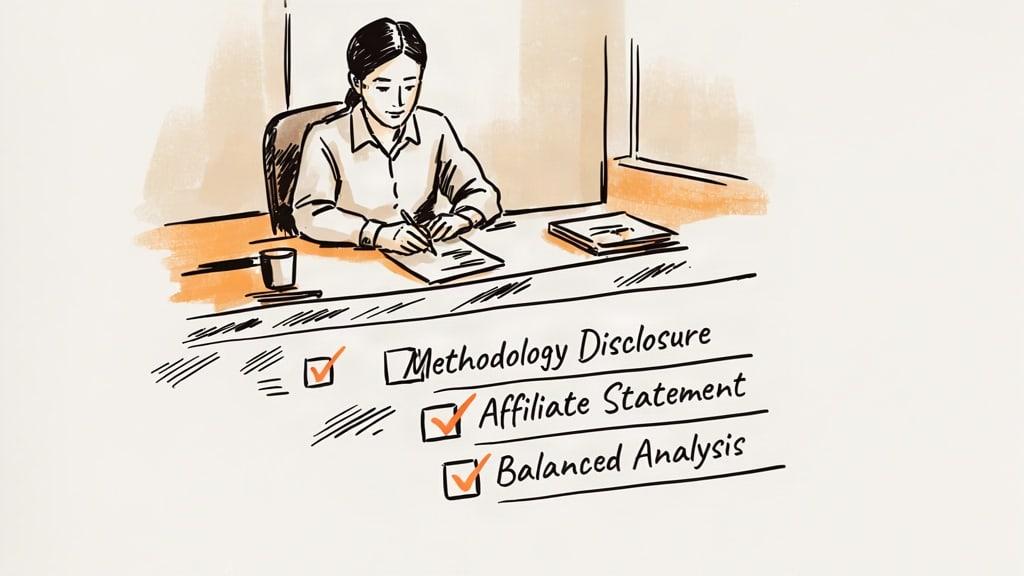
A trustworthy casino review combines three core elements: a published methodology explaining how casinos are assessed, explicit disclosure of any financial relationship between the review site and the operators it recommends, and balanced coverage that shows both strengths and documented weaknesses. Reviews more than 6-12 months old without a freshness update risk containing stale information about bonuses, licences, or payment methods.
This article explains how to identify honest reviews and what to verify before you rely on any single source. Understanding how a review site works, and whether it stands to profit from its recommendations, matters when you're weighing its conclusions.
Eligible options at a glance
The most credible review platforms publicly commit to a documented evaluation process and state clearly when affiliate relationships may influence their recommendations. Two sites widely recognised for transparent methodology are Casino Guru and AskGamblers. Both publish detailed pages explaining their rating criteria and dispute-handling processes.
Casino Guru details its assessment across 14 factors, including licensing, game fairness, and customer support, and applies a penalty-point system for violations. AskGamblers publishes a "How We Review Online Casinos" section and operates a "Casino Complaint Service" that mediates player disputes and publishes resolutions. Both platforms meet the core standard: readers can access a dedicated page that shows how a review is constructed, not merely what the conclusion is.
Selection criteria and evidence date
Data freshness: 12 November 2026
When shortlisting a review source, verify these criteria:
-
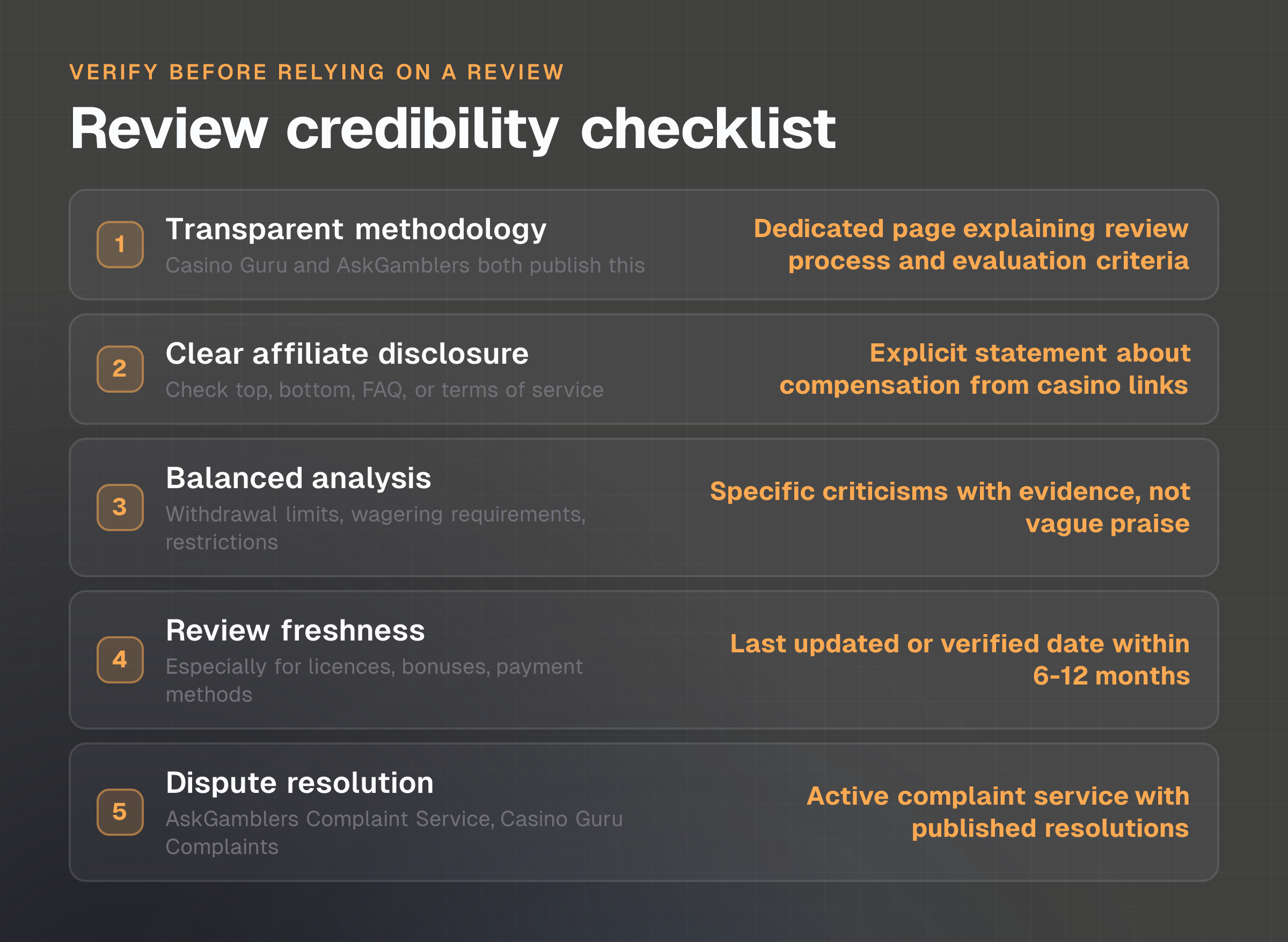
Transparent methodology. Does the site have a dedicated page explaining its review process, specific evaluation criteria (licensing, security, game selection, customer support), and how data is collected and verified? Casino Guru and AskGamblers both publish this.
-
Clear affiliate disclosure. Look for an explicit statement acknowledging whether the review site earns compensation when you click through to a casino. Reputable sites display this prominently, at the top or bottom of a page, in a FAQ, or in terms of service, often stating something like: "We may receive compensation from the casinos we review if you click on our links."
-
Balanced analysis. Does the review present both positives and negatives? Are criticisms specific and substantiated, withdrawal limits, wagering requirements, country restrictions, rather than vague or promotional? Research by the University of Hamburg (2022) on online review credibility found that reviews incorporating both positive and negative sentiment were perceived as more trustworthy by consumers than purely positive ones.
-
Review freshness. Is there a "last updated" or "last verified" date displayed? Information more than 6-12 months old without a freshness update may be outdated, especially regarding licences, bonus terms, or payment methods.
-
Reputation and dispute resolution. Does the site have a long-standing presence in the industry and actively engage with user feedback? AskGamblers' Complaint Service and Casino Guru's Complaints section are examples of mechanisms that build user trust by mediating disputes between players and casinos and publishing resolutions.
Operator trade offs
Highly detailed reviews offer more information but can overwhelm. Concise reviews are easier to digest but may lack depth. You'll need to balance these depending on your research style.
Single source vs. cross-reference. Relying solely on one review site, regardless of its reputation, carries the risk of absorbing potential biases or missing alternative perspectives. Cross-referencing multiple sources is advisable, even when one source meets all transparency criteria.
User reviews with caution. Player-submitted comments and ratings offer additional perspectives but require scrutiny. A study published in the Journal of Marketing Research (2018) highlighted the prevalence of fake online reviews and the difficulty consumers face in discerning them. Indicators of fake reviews include extreme sentiment, lack of specific details, and multiple reviews from new accounts posted in a short period. Moderated review sections reduce this risk but don't eliminate it.
Affiliate relationships. Understanding that a review site may earn a commission prevents you from mistaking a recommendation for a purely altruistic endorsement. Financial incentive may exist alongside honest assessment. These aren't mutually exclusive. Transparent disclosure allows you to weigh this yourself.
Checks before choosing
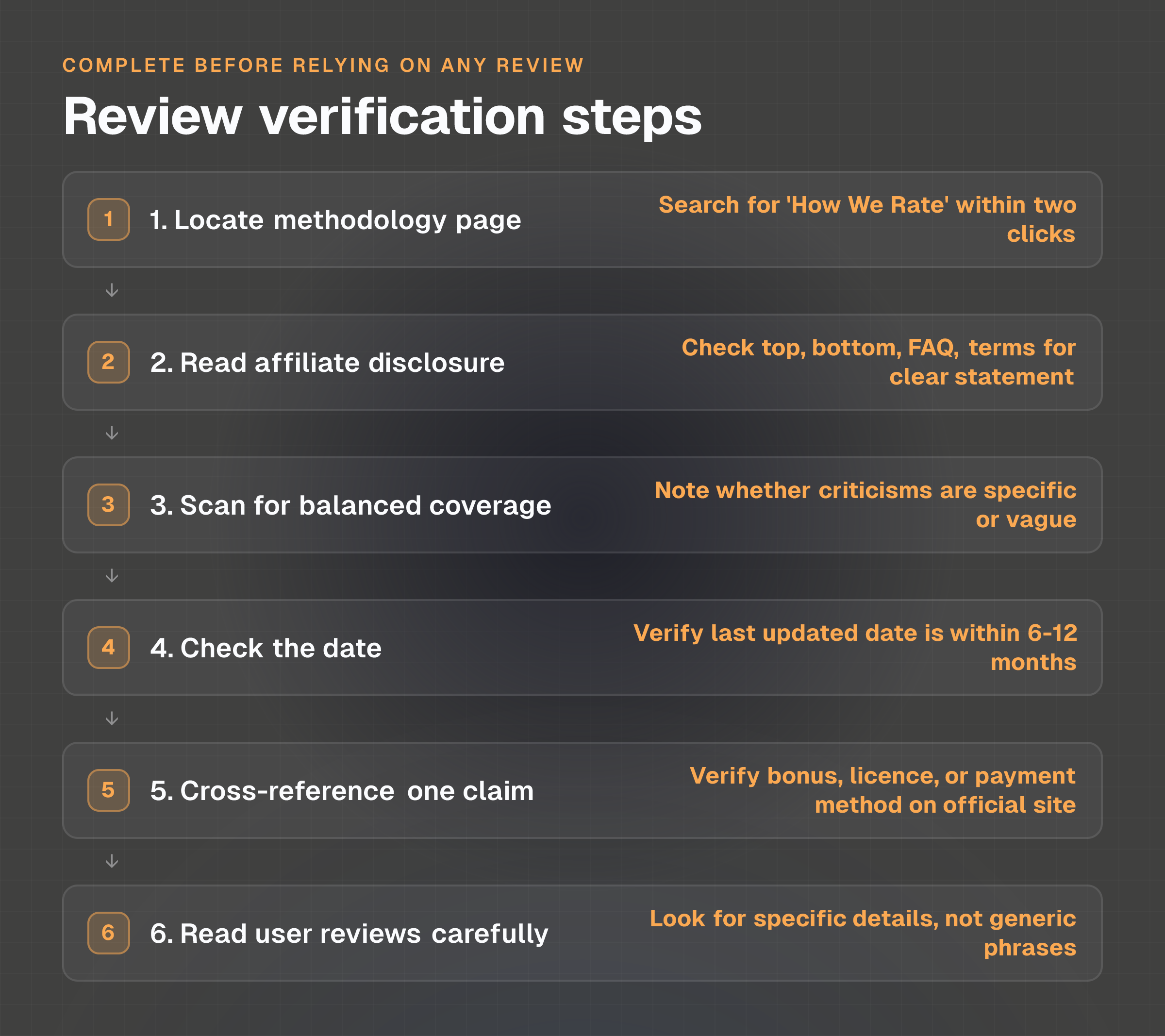
Before relying on a review, perform these steps:
-
Locate the methodology page. Search the review site for "How We Rate," "Review Process," or similar terms. If you can't find a dedicated explanation within two clicks, the transparency standard isn't clearly met.
-
Read the affiliate disclosure. Check the top and bottom of the review page, the FAQ section, and the terms of service. A clear statement should appear. If you find no disclosure after checking these locations, the site doesn't meet the standard.
-
Scan for balanced coverage. Read the full review, not just the headline or summary. Note whether criticisms are specific, "withdrawal requests take 5-7 working days" or "accounts from the following countries aren't accepted", or vague: "customer service was slow." Specific criticisms indicate substantive assessment.
-
Check the date. Verify when the review was last updated. No date visible? Ask yourself whether you can verify the current status of the information independently, for example, by checking the casino's licence or reviewing the bonus terms directly.
-
Cross-reference one claim. Pick one factual claim from the review, a bonus structure, a payment method, a licence jurisdiction, and verify it on the casino's official website or licence register. If the claim matches, confidence in the review's accuracy increases. If it doesn't, treat the review with caution.
-
Read user reviews carefully. If the site includes player feedback, note whether comments are moderated, whether they include specific details (withdrawal times, bonus issues), and whether the same phrase appears repeatedly across multiple reviews. Generic praise or complaint with no detail raises credibility concerns.
Important unknowns. This article doesn't cover the exact frequency with which casino policies change, the quantifiable impact of transparent methodology on user trust across different platforms, or the percentage of online casino reviews industry-wide that are considered fabricated or manipulated.