Online casinos explained: how they work

Online casinos are digital platforms that let you wager on casino games via the internet. To play safely as a beginner, you'll need to understand four key steps: choosing a licensed operator, setting up and verifying your account, depositing funds via a secure payment method, and knowing how games work before you play.
This guide covers what to check before you start. It explains how account setup and identity verification work, how withdrawal limits and payment processing affect your ability to access winnings, and where the practical limits of this article sit, because the online casino market is large and policies vary significantly between operators.
Finding and coverage: what this guide addresses
This guide answers one question: what do beginners need to know to open an account and play safely at an online casino?
It focuses on four areas. How to choose a licensed operator. What account registration and identity verification involve. How payment methods and withdrawal limits work. And common gaps in publicly available information.
The scope is deliberately bounded. This article doesn't rank individual casinos, review specific bonus offers, or test game fairness. It uses the definitions and process steps that apply across regulated online casino operators: how licensing works, what Know Your Customer (KYC) identity checks are, how Return to Player (RTP) and house edge affect game outcomes, and what wagering requirements mean for bonus winnings.
Guidance here applies to players in jurisdictions where online gambling is licensed and regulated. If you're considering an unlicensed or unregulated site, the protections outlined below don't apply.
Data and method: how online casinos are defined and structured
An online casino is a digital platform offering wagers on casino games. To understand how they operate, it's useful to separate four distinct units:
- Operators: The licensed companies that run the casino platform and hold the gambling licence from a regulatory authority (for example, the UK Gambling Commission or Malta Gaming Authority).
- Casinos: The branded websites or apps where players access games and accounts.
- Customers: Individual players who open accounts and make deposits.
- Transactions: Individual deposits, withdrawals, and wagers, each with a date, amount, and method.
When you open an account, you enter into a contract with the operator. The operator is responsible for holding a valid licence, implementing security (SSL encryption, shown as "https://" in the URL and a padlock icon), and offering responsible gambling tools.
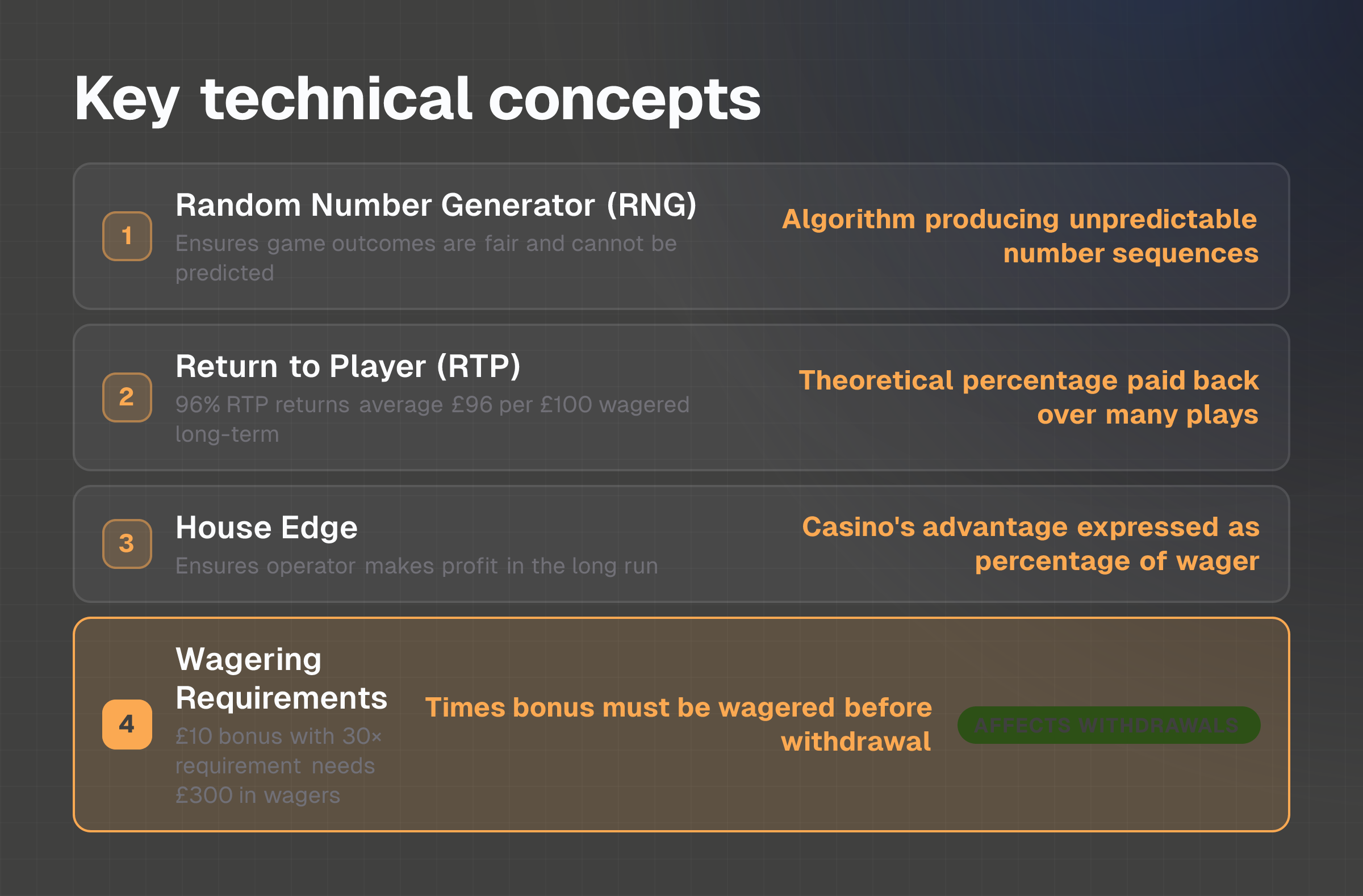
Key technical concepts you'll encounter:
Random Number Generator (RNG): A computer algorithm that produces sequences of numbers without discernible pattern, ensuring game outcomes are unpredictable and fair.
Return to Player (RTP): A theoretical percentage showing the average amount of wagered money a game pays back to players over a large number of plays. For example, a slot with 96% RTP returns an average of £96 per £100 wagered over time.
House Edge: The advantage the casino holds over players, expressed as a percentage of your initial wager. This ensures the operator makes a profit in the long run.
Wagering Requirements (Playthrough Requirements): Conditions attached to bonus funds or free spins that specify how many times the bonus amount must be wagered before you can withdraw winnings as cash.
Results and interpretation: what to check and how account setup works
Choosing a licensed operator
Before you deposit any money, verify that the casino holds a valid licence from a reputable authority. Check the operator's licence against the regulator's register. Licensing authorities include the UK Gambling Commission, Malta Gaming Authority, and Gibraltar Regulatory Authority. A valid licence indicates the operator must comply with standards for player protection, fair games, and secure financial handling.
Alongside licensing, check these:
Security: Does the website URL begin with "https://" and display a padlock icon? This indicates SSL encryption protecting your personal and financial data.
Game Selection: Does it offer the types of games you're interested in, slots, table games such as blackjack or roulette, live dealer games with real human dealers?
Payment Methods: Does it support deposit and withdrawal methods you can access?
Customer Support: What channels are available (live chat, email, phone) and when do they operate?
Account registration and identity verification
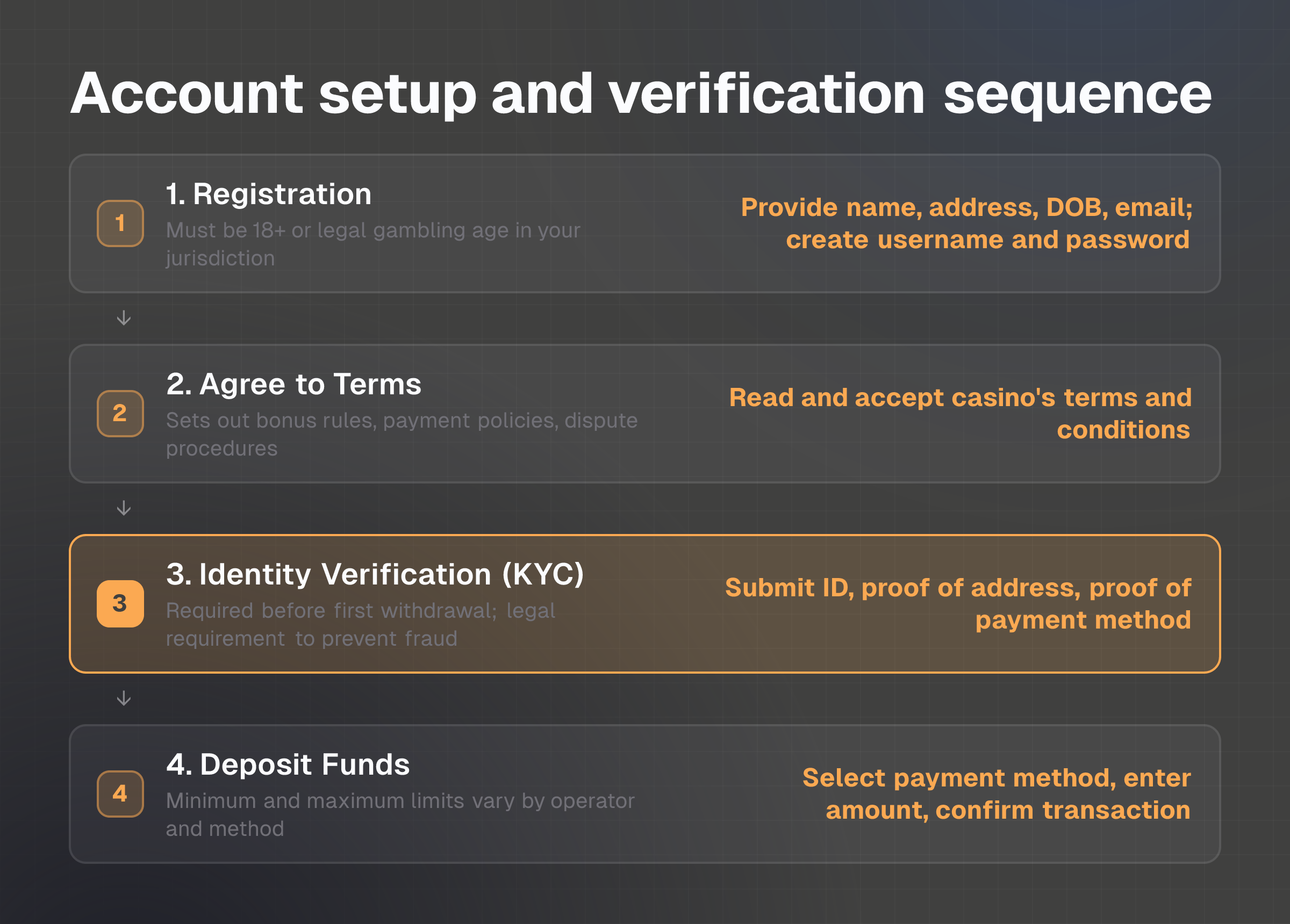
Registration involves three steps.
Create your account: Provide your name, address, date of birth, and email. Create a username and password. You must be 18 years old or older (or the legal gambling age in your jurisdiction) to open an account.
Agree to terms: Read and accept the casino's terms and conditions, which set out bonus rules, payment policies, and dispute procedures.
Identity verification (KYC): Before you can withdraw winnings for the first time, the operator must verify your identity. This is a legal requirement set by licensing authorities to prevent fraud, money laundering, and underage gambling.
KYC typically requires you to submit a copy of identification (passport or driving licence), proof of your current address (utility bill, bank statement, or similar), and sometimes proof that you own the payment method you're using (a bank statement or card statement showing your name).
Processing time for identity verification isn't standardised across operators. This article doesn't cover typical approval times, as delays and requirements vary. What to check before trusting no-KYC claims covers casinos claiming to operate without full identity checks.
Depositing funds and understanding bonuses
Once your account is open, you can deposit funds. Select a payment method (credit card, debit card, e-wallet, bank transfer, or prepaid card), enter an amount, and confirm the transaction.
Minimum and maximum deposit limits vary by operator and payment method. Most reputable casinos don't charge fees on deposits, but this isn't guaranteed across all operators.
Bonuses and promotions are common, but they come with conditions.
Wagering requirements specify how many times you must wager the bonus amount before you can withdraw it as cash. A £10 bonus with a 30× wagering requirement requires you to place £300 in wagers before you can withdraw.
Game restrictions mean some games may not count toward the wagering requirement, or may count at a reduced rate.
Time limits restrict how long you have to use the bonus (commonly 7 to 30 days).
Maximum bet limits cap how much you can stake on a single spin or hand while a bonus is active.
Read the full terms before accepting any bonus. Casino Bonus Terms Explained: What Can You Actually Withdraw? covers how to interpret these conditions.
Playing games and understanding fairness
Online casino games fall into three categories.
Slots: Digital slot machines with varying paylines, themes, and bonus features. The RNG ensures each spin is independent and unpredictable.
Table Games: Games like blackjack, roulette, and baccarat played against the house. Rules and odds are standardised across operators.
Live Dealer Games: Real-time games with human dealers on video stream, combining online convenience with a traditional casino experience.
All games use an RNG to ensure fair outcomes. Understanding RTP and house edge helps you make informed decisions.
A slot with a 96% RTP means that over many thousands of plays, players receive an average of 96 pence back for every pound wagered. Individual sessions will vary widely. House edge is the inverse: it represents the casino's long-term profit margin. A 4% house edge (100% minus 96% RTP) favours the operator. Neither RTP nor house edge guarantees your personal result. They describe long-term statistical outcomes, not what you'll experience in one session.
Withdrawing winnings
To withdraw funds, request a withdrawal via the casino's cashier, select your preferred withdrawal method, and confirm.
Withdrawal limits typically include:
Minimum withdrawal: Often £10, £20, though this varies.
Maximum withdrawal: Some operators set daily, weekly, or monthly caps.
Bonus withdrawal limits: Many casinos cap the amount you can withdraw from bonus winnings (for example, a maximum of £100 regardless of how much you won).
Processing times vary by method and operator. This article doesn't provide average times, as variability is high. Casino Withdrawal Times: Processing and Payment Delays addresses how to interpret published withdrawal timeframes.
Identity verification may be required before your first withdrawal if not already completed during registration. Delays in KYC can significantly slow down your access to winnings.
Limits and practical use: what this article does not cover
This guide is grounded in definitions, account setup processes, and common policy types across regulated operators. It has deliberate gaps.
Individual casino policies: Specific withdrawal limits, bonus terms, and processing times aren't listed here because they vary significantly between operators. Use the casino directory to compare individual sites.
Payment method details: Deposit and withdrawal fees, processing times, and supported countries differ by method and operator. Casino Crypto Payments: Check Networks, Fees and Withdrawals and What Is a Bitcoin Casino? Payments and Withdrawal Rules address specific payment types in detail.
Game-by-game RTP: Actual RTP percentages for individual games are published by game providers and casinos but aren't catalogued here.
Complaint data and payout reliability: This article doesn't make claims about how often casinos pay out withdrawals or how disputes are resolved. How to Complain About an Online Casino in Great Britain explains the process if a dispute arises.
Responsible gambling resources: While online casinos offer deposit limits, session limits, self-exclusion, and reality checks, this guide doesn't evaluate these tools. If you're concerned about your gambling habits, external resources such as GamCare and BeGambleAware provide support independent of any operator.
Use How to Choose an Online Casino: Checks Beyond the Bonus to develop a personal checklist, and How WhatCasino ranks and discloses to understand how comparison data is structured and sourced.